Periodic Table |
 |
 |
 |
 |
 |
 |
 |
| What is the Periodic Table Showing? | Periodicity |
The INTERNET Database of Periodic Tables
There are thousands of periodic tables in web space, but this is the only comprehensive database of periodic tables & periodic system formulations. If you know of an interesting periodic table that is missing, please contact the database curator: Mark R. Leach Ph.D. The database holds information on periodic tables, the discovery of the elements, the elucidation of atomic weights and the discovery of atomic structure (and much, much more).
| Year: 1976 | PT id = 1306, Type = data |
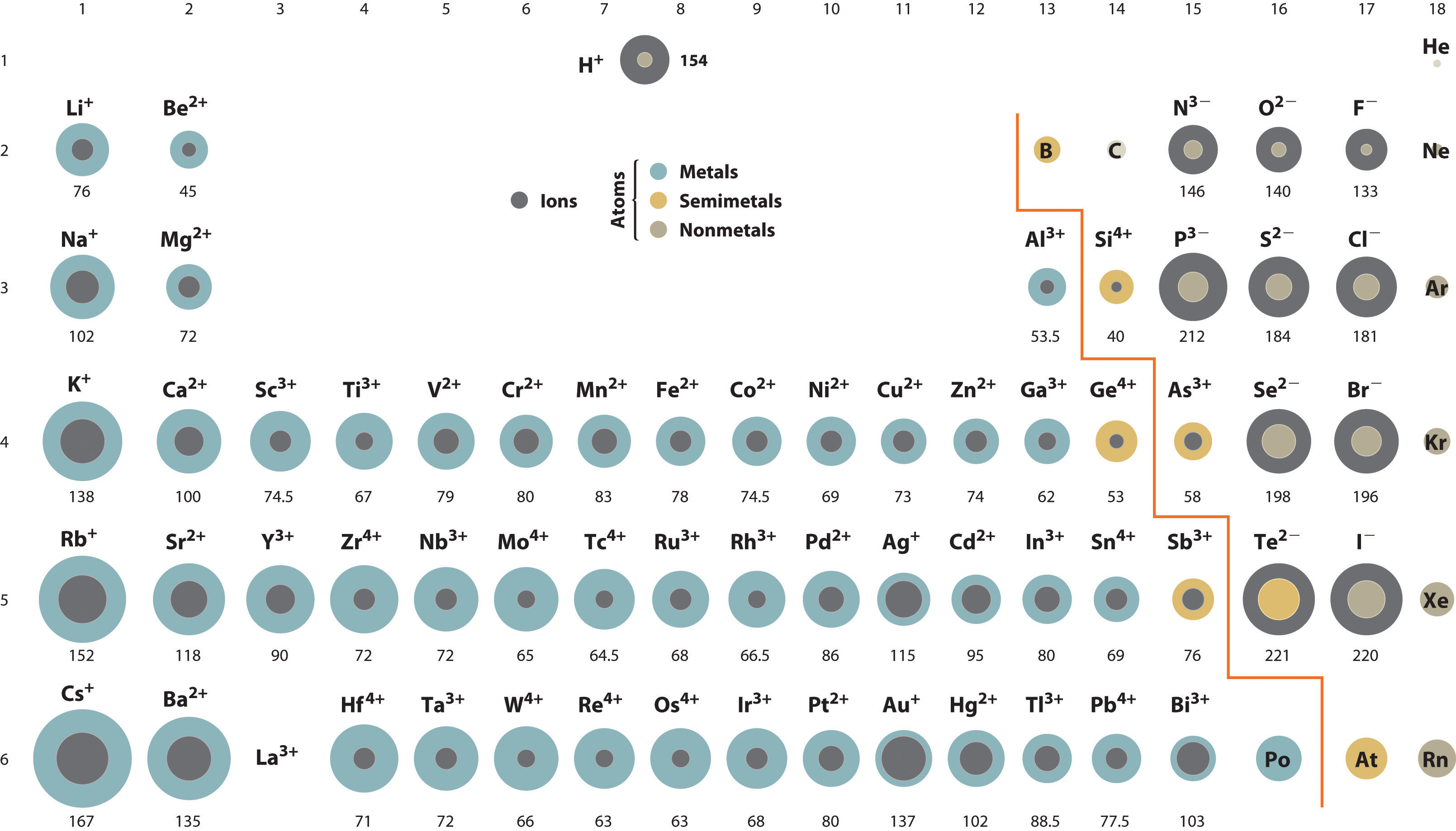
Atomic & Ionic Radii Periodic Table
A periodic table showing atomic and ionic radii from Chem Libre Texts. The text says: Figure 3.7. Source: Ionic radius data from R. D. Shannon, "Revised effective ionic radii and systematic studies of interatomic distances in halides and chalcogenides," Acta Crystallographica 32, no. 5 (1976): 751–767.
Mark Leach writes:
"I came across this periodic table while researching an exam question with a student: Which ion is larger: Na+ or F–?
"Note that N3–, O2–, F–, Ne, Na+, Mg2+ & Al3+ are all isoelectronic in that they all have the same electronic configeration: 1s2, 2s2, 2p6. The only property that changes is the nuclear charge, which increases from + 7 to + 11.
"Thus, N3– will be the largest and Al3+ the smallest in this set of isoelectronic species as the increasing nuclear charge pulls the electrons closer. Likewise from P3– to Sc3+ which are all 1s2, 2s2, 2p6, 3s2, 3p6."
|
|
|
| What is the Periodic Table Showing? | Periodicity |
© Mark R. Leach Ph.D. 1999 –
Queries, Suggestions, Bugs, Errors, Typos...
If you have any:
Queries
Comments
Suggestions
Suggestions for links
Bug, typo or grammatical error reports about this page,please contact Mark R. Leach, the author, using mark@meta-synthesis.com
This free, open access web book is an ongoing project and your input is appreciated.